Welcome to our Feng Shui Blog – A treasure of good feng shui knowledge, real case studies and our results achieved in the past because of our authentic knowledge.
Warnings!: There are people who uses Master Alan’s name to promote themselves and courses. Please verify with us if you have doubts of such claims.
This is a case where I attended to indirectly back in around 2015/6. the story began with the family engaging a foreign feng shui master to check on their parents grave because majority of the family members weren’t doing well including this person that engaged this master.
First Master
It was around 2012/3 back then. The foreign master said their parents grave wasn’t good and thus recommended they relocate their parents.
They went around the around and neighboring town to find a good burial plot. after some weeks they found this grave spot and the master said this is the good spot or in feng shui lingo, the Xue spot 穴.
San Yuan 三元 has many schools and sub schools of feng shui theories and we from the Wu Chang 无常流 lineage has been particularly lucky that we come with a strong tradition of practicing what is truly feng shui at it’s core unlike many schools that mix other systems into their practice.
We are also very contrast to majority of the practitioners that talks about lucky item feng shui which is so off track from traditional feng shui.
This is why our audit cases have yielded high success rates over the years and generations from our Grand master’s time.
Today, I’d like to share another real-life Business Feng Shui success story—one that illustrates how the right environment (a.k.a. Feng Shui) can become a competitive advantage for a business.
This is not a story about magic.
It is a story about leadership, strategy, and how the right Feng Shui can support both.
The Background
This company is a well-established Malaysian-owned enterprise that has been operating successfully for many years.
When the founder passed away, ownership was inherited by his son, who resides overseas. Since he was unable to oversee the company’s daily operations personally, a new CEO was appointed in the second quarter of 2024 to lead the organisation into its next phase of growth.
Like many successful companies, management wanted every possible advantage.
Towards the second half of 2024, they engaged an established and highly recognised Feng Shui consultant to conduct a comprehensive audit of the premises. The recommendations were implemented diligently, including water features, corner remedies, metal enhancements and other Feng Shui activations.
On paper, everything appeared to have been done correctly.
The true purpose of Sheng Ji (Live Grave 生基) has never been about wealth.
Its original intention is much simpler—and far more meaningful.
To preserve health, prolong life, and create an opportunity for recovery when life seems to be slipping away.
This is one such story.
When Everything Started Going Wrong
On 1 March 2026, I received a message from my client.
His father, a man in his late seventies, had been involved in a car accident after crashing into a tree.
Thankfully, the injuries did not initially appear serious.
The family breathed a sigh of relief.
But that relief did not last long.
A few days later, while recovering in hospital, his father collapsed in the toilet. He appeared increasingly weak and exhausted. Doctors discovered a persistent lung infection that refused to respond to several days of antibiotics.
Something wasn’t right.
A CT scan was finally ordered.
The results revealed that he had actually suffered multiple micro-strokes.
The family’s optimism quickly turned into uncertainty.
Here is a write up by a Hong Kong Feng Shui Master about why Louis Koo does well in his career. Read On…
I will put in my thoughts below :
Louis Koo, a devout believer in metaphysics and feng shui, enjoys enduring success (Part 1)
Louis Koo, a powerful actor and film mogul in Hong Kong, has enjoyed a stable career and unwavering fortune for many years, widely believed to be attributed to feng shui arrangements that boost his luck. It’s well-known that he respects traditional metaphysics, arranging feng shui in his office and residence. His Kwun Tong office, with its “boiling water steaming horse for wealth” and “golden bell for warding off evil and changing fortune,” is often interpreted as the key to his career success.
However, in reality, these feng shui arrangements are merely superficial, a facade for outsiders, and not the true reason for his good fortune.
The core of Louis Koo’s truly remarkable luck, profound blessings, constant support from benefactors, and consistent box office success lies in his decades of quietly accumulating good deeds and virtuous deeds. For many years, he has quietly dedicated himself to philanthropy, donating to build hundreds of Hope Primary Schools, school buildings, and welfare facilities in remote and impoverished areas of mainland China. He has sponsored countless impoverished children’s education, helped numerous poor families escape poverty, and enabled countless children to overcome illiteracy and change their destinies.
Such accumulated, selfless acts of kindness have amassed immense blessings and positive energy, truly protecting him and benefiting his career.
His life’s success, his illustrious reputation, his best-selling works, and his unwavering fortune are not merely superficial; they are a true manifestation of his profound virtue and the great blessings that come from great kindness. Therefore, the film version of “A Step into the Past,” which he produced and starred in, achieved both critical and commercial success, propelling his career to its peak.
A traditional house stands beside a sleek modern office building on a city street corner.
Is there a difference?
In summary, the theory is same across residential and commercial but the emphasis in terms of application, there is a difference. Read on to find out more on my article with Wargabiz.
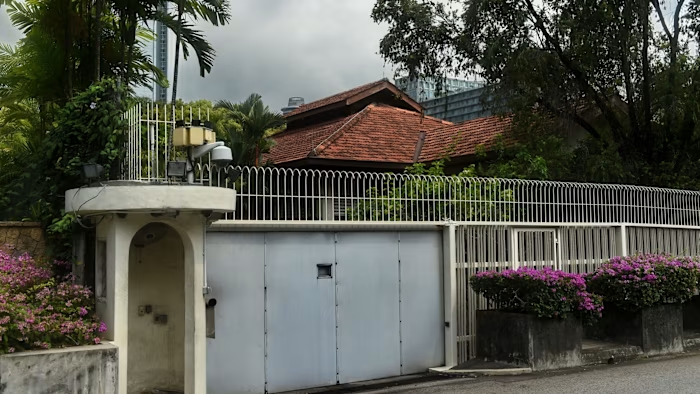
Recently, I came across a video showcasing Lee Kuan Yew’s ancestral home in Dapu, China.
As expected, many proponents of San He, Yang Gong, and Liu Jiang Dong Feng Shui cite this house as a classic case study. According to the narrative, the Feng Shui of this ancestral residence was so powerful that it eventually produced one of the greatest statesmen of modern Asia — Lee Kuan Yew himself.
It is an attractive story.
After all, if a single house could produce a leader who transformed a tiny island nation into a global powerhouse, who wouldn’t want to learn the secrets behind it?
Many students do.
Many sign up for courses hoping to uncover the hidden formula.
But I have always had a problem.
Perhaps it is the engineer in me.
I have never been comfortable accepting conclusions simply because they sound impressive. Before believing a claim, I prefer to examine the evidence, follow the timeline, and ask a simple question:
Does the story actually make sense?
So let us investigate.
The First Question: What About Lee Kuan Yew’s Father?
If the Dapu ancestral house was truly responsible for producing extraordinary descendants, then surely the influence should be visible in the generations closest to it.
Lee Kuan Yew’s father was Lee Chin Koon (1903–1997), a third-generation Straits Chinese of Hakka descent.
By all accounts, he lived a respectable but largely ordinary life.
He worked for Shell Oil Company and later at the prestigious jewelry and watch retailer B.P. de Silva in Singapore.
He was not a political leader.
He was not a renowned scholar.
He was not a business tycoon.
In fact, Lee Kuan Yew himself described his father as having a difficult temper and a serious gambling habit.
The family experienced financial hardship after the Great Depression, and much of the responsibility for holding the household together fell upon Lee Kuan Yew’s mother, Chua Jim Neo.
When we examine the historical record, Lee Chin Koon appears to have been an average man living an average life.
Nothing in his biography immediately suggests the emergence of an extraordinary Feng Shui effect.
More interestingly, Lee Chin Koon was not even born in Dapu.
He was born in Semarang, Indonesia, before eventually moving to Singapore.
This raises an important question.
If the Dapu house was the source of such immense fortune and talent, why do we not see stronger evidence of it in the generation immediately following it?
The Second Question: What About Lee Kuan Yew Himself?
Perhaps the influence skipped a generation?
Let us look at Lee Kuan Yew.
Where was he born?
Not in Dapu.
Not even in China.
Lee Kuan Yew was born on 16 September 1923 in a two-storey bungalow at 92 Kampong Java Road, Singapore.
The future Prime Minister who would eventually guide Singapore through independence and nation-building never lived his childhood in the famous Dapu house.
Again, we encounter a logical challenge.
If a house can profoundly influence a person’s destiny, surely the house one actually lives in should matter more than a house one has never lived in.
Otherwise, should we all abandon our current homes and rush back to trace our ancestral residences several generations ago?
The argument becomes difficult to sustain.
The Missing Generation
What fascinates me most is not Lee Kuan Yew’s success.
It is the apparent gap in the story.
If the Dapu house was truly so powerful, why was Lee Kuan Yew’s father’s generation relatively ordinary?
Why does the Feng Shui appear to bypass the second generation and suddenly manifest in the third and fourth generations?
This is where many case studies stop asking questions.
But these questions matter.
Because reality is rarely explained by a single factor.
Could There Be Other Explanations?
Perhaps the family benefited from factors entirely unrelated to the Dapu house.
Perhaps it was Lee Kuan Yew’s exceptional education.
Perhaps it was the environment of colonial Singapore.
Perhaps it was the influence of his remarkable mother.
Perhaps it was the Feng Shui of the homes they actually lived in. Could it have been the magic of 38 Oxley Street, the house he lived in since 1940s’?
Or perhaps, if we are discussing ancestral influences, the real source could have been an ancestral grave rather than an ancestral house.
In traditional Feng Shui, Yin House Feng Shui (ancestral graves) has long been considered capable of influencing future generations.
If someone argued that an ancestral grave contributed to the emergence of an extraordinary descendant, I would find that a much more plausible discussion.
But the Dapu case revolves around a house.
And houses primarily influence those who live in them.
That distinction is important.
Why This Matters
The issue is bigger than Lee Kuan Yew.
It concerns how we evaluate Feng Shui itself.
Too often, people are captivated by extraordinary stories.
A famous person.
A successful businessman.
A wealthy family.
Then a convenient explanation is attached afterward.
“This happened because of that house.”
The story spreads.
The legend grows.
And eventually the story becomes accepted as fact.
Yet genuine Feng Shui should withstand scrutiny.
If a theory is true, it should survive questioning.
It should survive historical investigation.
It should survive logic.
Blind belief may create followers.
But critical thinking creates practitioners.
As Feng Shui moves into the future, I believe this distinction will become increasingly important.
Will the next generation inherit a discipline built upon careful observation, evidence, and natural principles?
Or one built upon stories that nobody dares question?
Many a times just because you cannot feel the energy, it doesn’t mean it does not exists. Just like gravity acting on us seamlessly, this is precisely how feng shui works.
I cannot stop emphasizing that authentic feng shui is not about crystals, lucky cat, piyao or wealth corner thing. These are just purely psychological in nature.
Real feng shui is about observing how Qi is flowing with the premise and then we maximize the good Qi while dispelling the bad Qi thereby improving our livelihood.
Office politics can become so toxic that instead of getting things done, time is wasted on internal conflicts, power struggles, and endless disagreements.
Teams break down. Decisions get delayed. And over time, the entire company begins to suffer.
Profits decline. Customers leave — frustrated by poor service. Talented employees walk away for better opportunities… or worse, become your competitors.
What many business owners, CEOs, and Managing Directors fail to realise is this: these issues are not always just “people problems.”
Sometimes, they are the effects of poor Feng Shui.
Just because you cannot see, touch, or measure Feng Shui does not mean it isn’t real. It simply means it operates beyond your immediate awareness.
Think about gravity. You don’t see it — yet it influences you every second of your life.
Feng Shui works in much the same way. It quietly shapes behaviour, relationships, and outcomes within your space.
If your business is facing persistent internal issues with no clear solution, it may be time to look beyond the obvious.
Get your office or business Feng Shui assessed today — before the hidden costs become irreversible.