

Recently, I came across a video showcasing Lee Kuan Yew’s ancestral home in Dapu, China.
As expected, many proponents of San He, Yang Gong, and Liu Jiang Dong Feng Shui cite this house as a classic case study. According to the narrative, the Feng Shui of this ancestral residence was so powerful that it eventually produced one of the greatest statesmen of modern Asia — Lee Kuan Yew himself.
It is an attractive story.
After all, if a single house could produce a leader who transformed a tiny island nation into a global powerhouse, who wouldn’t want to learn the secrets behind it?
Many students do.
Many sign up for courses hoping to uncover the hidden formula.
But I have always had a problem.
Perhaps it is the engineer in me.
I have never been comfortable accepting conclusions simply because they sound impressive. Before believing a claim, I prefer to examine the evidence, follow the timeline, and ask a simple question:
Does the story actually make sense?
So let us investigate.
The First Question: What About Lee Kuan Yew’s Father?
If the Dapu ancestral house was truly responsible for producing extraordinary descendants, then surely the influence should be visible in the generations closest to it.
Lee Kuan Yew’s father was Lee Chin Koon (1903–1997), a third-generation Straits Chinese of Hakka descent.
By all accounts, he lived a respectable but largely ordinary life.
He worked for Shell Oil Company and later at the prestigious jewelry and watch retailer B.P. de Silva in Singapore.
He was not a political leader.
He was not a renowned scholar.
He was not a business tycoon.
In fact, Lee Kuan Yew himself described his father as having a difficult temper and a serious gambling habit.
The family experienced financial hardship after the Great Depression, and much of the responsibility for holding the household together fell upon Lee Kuan Yew’s mother, Chua Jim Neo.
When we examine the historical record, Lee Chin Koon appears to have been an average man living an average life.
Nothing in his biography immediately suggests the emergence of an extraordinary Feng Shui effect.
More interestingly, Lee Chin Koon was not even born in Dapu.
He was born in Semarang, Indonesia, before eventually moving to Singapore.
This raises an important question.
If the Dapu house was the source of such immense fortune and talent, why do we not see stronger evidence of it in the generation immediately following it?
The Second Question: What About Lee Kuan Yew Himself?
Perhaps the influence skipped a generation?
Let us look at Lee Kuan Yew.
Where was he born?
Not in Dapu.
Not even in China.
Lee Kuan Yew was born on 16 September 1923 in a two-storey bungalow at 92 Kampong Java Road, Singapore.
The future Prime Minister who would eventually guide Singapore through independence and nation-building never lived his childhood in the famous Dapu house.
Again, we encounter a logical challenge.
If a house can profoundly influence a person’s destiny, surely the house one actually lives in should matter more than a house one has never lived in.
Otherwise, should we all abandon our current homes and rush back to trace our ancestral residences several generations ago?
The argument becomes difficult to sustain.
The Missing Generation
What fascinates me most is not Lee Kuan Yew’s success.
It is the apparent gap in the story.
If the Dapu house was truly so powerful, why was Lee Kuan Yew’s father’s generation relatively ordinary?
Why does the Feng Shui appear to bypass the second generation and suddenly manifest in the third and fourth generations?
This is where many case studies stop asking questions.
But these questions matter.
Because reality is rarely explained by a single factor.
Could There Be Other Explanations?
Perhaps the family benefited from factors entirely unrelated to the Dapu house.
Perhaps it was Lee Kuan Yew’s exceptional education.
Perhaps it was the environment of colonial Singapore.
Perhaps it was the influence of his remarkable mother.
Perhaps it was the Feng Shui of the homes they actually lived in. Could it have been the magic of 38 Oxley Street, the house he lived in since 1940s’?
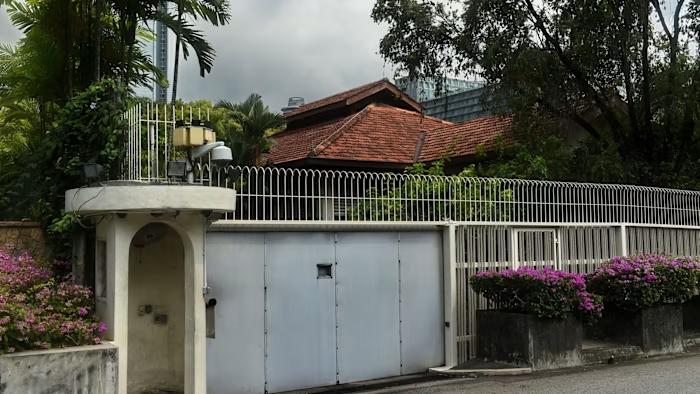
Or perhaps, if we are discussing ancestral influences, the real source could have been an ancestral grave rather than an ancestral house.
In traditional Feng Shui, Yin House Feng Shui (ancestral graves) has long been considered capable of influencing future generations.
If someone argued that an ancestral grave contributed to the emergence of an extraordinary descendant, I would find that a much more plausible discussion.
But the Dapu case revolves around a house.
And houses primarily influence those who live in them.
That distinction is important.
Why This Matters
The issue is bigger than Lee Kuan Yew.
It concerns how we evaluate Feng Shui itself.
Too often, people are captivated by extraordinary stories.
A famous person.
A successful businessman.
A wealthy family.
Then a convenient explanation is attached afterward.
“This happened because of that house.”
The story spreads.
The legend grows.
And eventually the story becomes accepted as fact.
Yet genuine Feng Shui should withstand scrutiny.
If a theory is true, it should survive questioning.
It should survive historical investigation.
It should survive logic.
Blind belief may create followers.
But critical thinking creates practitioners.
As Feng Shui moves into the future, I believe this distinction will become increasingly important.
Will the next generation inherit a discipline built upon careful observation, evidence, and natural principles?
Or one built upon stories that nobody dares question?
Nature, as always, will decide.
References
- Lee Kuan Yew – Wikipedia
- Lee Kuan Yew Was Born in Kampong Java on This Day in 1923
- https://gemini.google.com/share/f1ac500d401c
- https://www.facebook.com/share/r/1PS77qNkst/
- 38 Oxley Road – Wikipedia
Discover more from Feng Shui Consultant Malaysia
Subscribe to get the latest posts sent to your email.